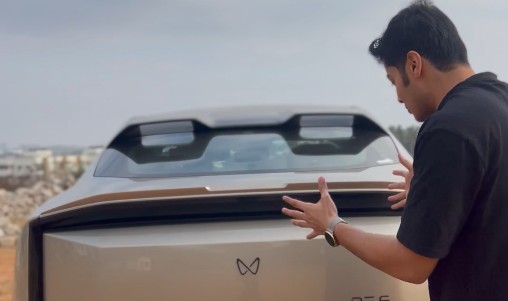
The automotive world is buzzing about Mahindra’s new “Born Electric” range. The Mahindra BE 6e has finally dropped, and let’s be honest it looks like it drove straight off the set of a sci-fi movie. With its sharp cuts, “fighter jet” cockpit, and that massive glass roof, it is easily one of the most exciting launches we’ve seen in India this year.
But while everyone is talking about the 0-100 km/h timings and the futuristic INGLO platform, there is a critical “invisible” factor that many buyers might miss until they are 200 kilometers into their first road trip: Rear Seat Fatigue.
If you are eyeing the BE 6e (or any long-range EV) as your next family highway cruiser, you need to look past the spec sheet and look at the floor.
The “High Floor” Problem in EVs
Here is the technical reality that marketing brochures often skip. Most modern EVs, including the BE 6e, are built on a “skateboard” platform. This means the massive battery pack is mounted flat along the floor of the car.
While this is great for handling (low center of gravity), it creates a specific problem for passengers: it raises the floor height.
In a traditional petrol or diesel car (ICE), the floor is lower, allowing your legs to drop naturally, providing decent support for your thighs. In an EV, because the floor is raised to accommodate the battery, your feet sit higher up.
The “Knees-Up” Effect in an EV Car
So, how does this affect the Mahindra BE 6e?
Despite having a decent wheelbase, the combination of the raised floor and the rear seat height creates a “knees-up” seating position. When your knees are pushed up:
- Under-Thigh Support Vanishes: Your thighs no longer rest on the seat cushion; they float above it.
- Pressure Points Shift: All your body weight shifts to your tailbone (hips) rather than being distributed along your legs.
- Fatigue Sets In: On a 15-minute test drive, you won’t notice it. On a 4-hour drive to Goa or Bengaluru? Your rear passengers will feel exhausted.
The BE 6e tries to compensate with a reclining backrest and a spacious cabin feel thanks to the panoramic sunroof, but the physics of the battery pack is hard to hide.
Coupe Design vs. Practicality
The BE 6e is a “Sports Electric Vehicle” with a coupe-like sloping roofline. While Mahindra has managed to carve out decent headroom (scooping out the roof liner), the window line is high. Combine a high window line with a low seating position relative to the floor, and rear passengers might feel a bit “hemmed in,” despite the large glass roof.
What to Look for When You Test Drive: Don’t just sit in the driver’s seat. If this is a family car, take your tallest family member along and ask them to sit in the back for at least 10-15 minutes.
- Check the Gap: Slide your hand under their knees. Is there a gap? If yes, that’s a recipe for fatigue.
- Foot Room: Can you slide your feet under the front seats? Often, battery hardware blocks this space in EVs, limiting how much you can stretch out.
- Suspension Comfort: EVs are heavy. Suspension has to be stiff to manage that weight. Check if the BE 6e absorbs sharp bumps or if it tosses rear passengers around.
The Verdict
The Mahindra BE 6e is a stunning piece of engineering and design. It puts Indian EVs on the global map. However, “Long Range” on the battery doesn’t always equal “Long Comfort” for the passengers.
If you are buying the BE 6e primarily for self-driving, it’s a no-brainer. But if you are looking for a chauffeur-driven experience or a long-distance family hauler, pay extremely close attention to that rear seat geometry.
Have you tested the BE 6e yet? Did you feel the “knees-up” issue? Let me know in the comments below!