
The compact SUV market is absolutely exploding right now, and the battle lines are being drawn in the highly contested ₹11–12 lakh segment. If you are in the market for a commanding daily driver, you’ve likely shortlisted the Honda Elevate and the aggressively relaunched Renault Duster.
But here at autocritic.in, we don’t just look at the brochures; we look at the real-world value. Today, we are breaking down a fascinating variant paradox.
On one side, we have the base variant Honda Elevate SV, priced at ₹11,67,590. On the other, the second-tier Renault Duster Evolution variant, coming in at an incredibly competitive ₹11,39,000.
Both SUVs demand a nearly identical budget. Yet, what you actually get for your hard-earned money will completely blow your mind. Let’s dive into this variant clash!
(For a deep dive into the complete Duster lineup, be sure to check out our comprehensive Renault Duster variant comparison for India
The Exterior Face-Off: Steel vs. Alloys
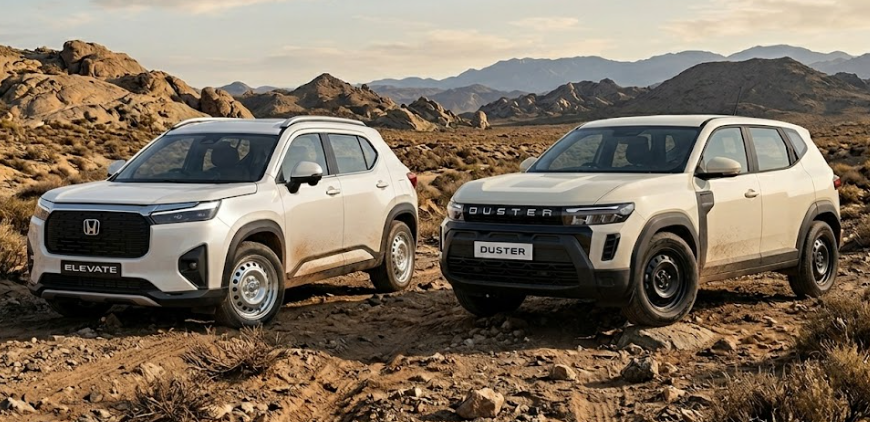
First impressions matter, and the exterior equipment immediately highlights the difference in variant hierarchy.
Because the Elevate SV is a base model, Honda equips it with standard steel wheels. It’s functional, but it lacks the visual punch you expect from an SUV in this bracket. In contrast, the Duster Evolution treats you to sleek, factory-fitted alloy wheels right out of the gate, dramatically enhancing its road presence and stance.
Both vehicles bring modern lighting to the table, featuring crisp LED DRLs at the front and LED taillights at the rear. However, Renault takes the aesthetic a step further. The Duster boasts a stunning connected LED tail lamp design—a massive trend dominating the premium car market today—giving it a futuristic, wide, and unmistakable signature at night.
The Interior Shock: Bare-Bones vs. Fully Loaded
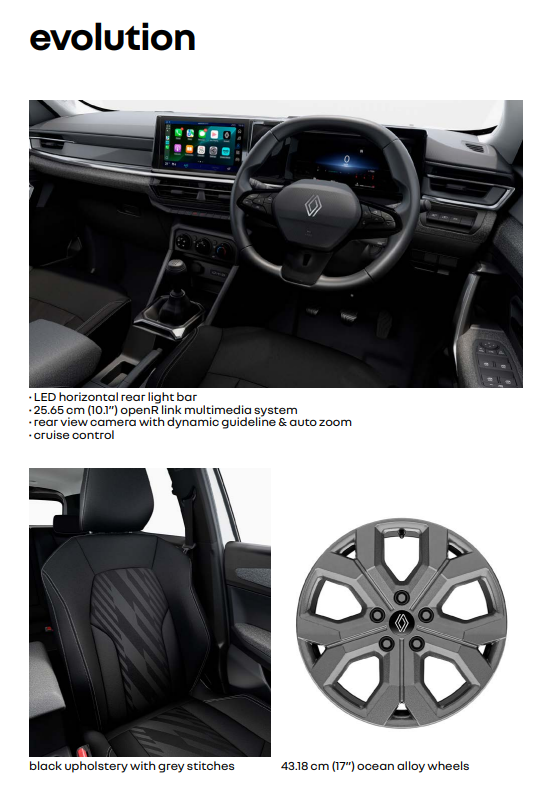
If the exterior differences caught your attention, what you get inside will absolutely blow your mind. Step into the Elevate SV, and you are greeted by a glaring omission: there is no infotainment system. You get a blank space on the dashboard, meaning you will immediately need to spend aftermarket money just to get basic music and navigation.
Switch over to the Duster Evolution, and you are stepping into a technological hub that feels lightyears ahead. Despite being priced lower, it comes equipped with a massive, crisp touchscreen infotainment system. But Renault didn’t stop there. Instead of traditional analogue dials, the Duster gives you a full digital instrument cluster, putting navigation, vehicle stats, and media right in your line of sight.
To top it all off, the Duster Evolution brings Cruise Control to the table. Having cruise control in what is essentially a lower-mid variant makes it absolutely crazy amazing for highway cruising, completely shedding the “base model” stigma. In terms of cabin features, the Duster simply blows the Elevate away.
Under the Hood: The Turbo vs. Naturally Aspirated Battle
Features are great, but how do they drive? This comparison gives us a textbook example of the two dominant engine philosophies in the modern automotive world: Naturally Aspirated (NA) vs. Turbocharged.
The Honda Elevate SV is powered by a Naturally Aspirated i-VTEC engine.
- How it works: An NA engine relies purely on atmospheric pressure to pull air into the combustion chamber.
- The Feel: This results in a highly predictable, incredibly smooth, and linear power delivery. Honda’s VTEC engines are famous for loving high RPMs. It’s refined and bulletproof, but it takes a moment to build up its peak power.
The Renault Duster Evolution packs a Turbocharged engine.
- How it works: A turbocharger uses exhaust gases to spin a turbine, which forces highly compressed air into the engine. More air means more fuel can be burned, creating a bigger explosion.
- The Feel: The result is a massive surge of torque very low in the rev range. When the turbo “spools up,” you get a sudden, punchy push back into your seat. It makes overtaking on the highway effortless and gives the heavy SUV a sprightly, aggressive, and exciting dynamic that an NA engine struggles to match without dropping down a gear.
The Final Verdict
The numbers don’t lie. For the exact same budget—and actually saving a few thousand rupees—the Renault Duster Evolution offers a radically different ownership experience compared to the Honda Elevate SV. While Honda delivers legendary engine refinement, buying a base variant in 2026 means sacrificing essential tech like a touchscreen and alloy wheels.
The Duster Evolution flips the script, proving that you don’t need to buy the top-spec model to get connected LEDs, digital clusters, cruise control, and the thrilling punch of a turbo engine.
Which one would you park in your garage? Let’s keep the conversation going in the comments below!
For a detailed breakdown and review of the Renault Duster, please do check out my video
Watch the Full Review
Subscribe to Auto Critic for more updates.