
In the Indian automotive landscape, summer isn’t just a change in weather—it is a mechanical gauntlet. When ambient temperatures in regions like Rajasthan or the Deccan Plateau breach 48°C, the thermal load on your vehicle’s sub-systems reaches a breaking point. We are talking about cabin temperatures that can reach 70°C and tarmac that can literally melt cheaper tyre compounds.
At AutoCritic, we move past the superficial “park in the shade” advice. We look at the engineering reality of heat soak, fluid degradation, and molecular stress. If you want to know how to protect your car this summer, you need to understand the science behind it.
1. The HVAC Battlefield: Recovering Your Cabin’s Climate
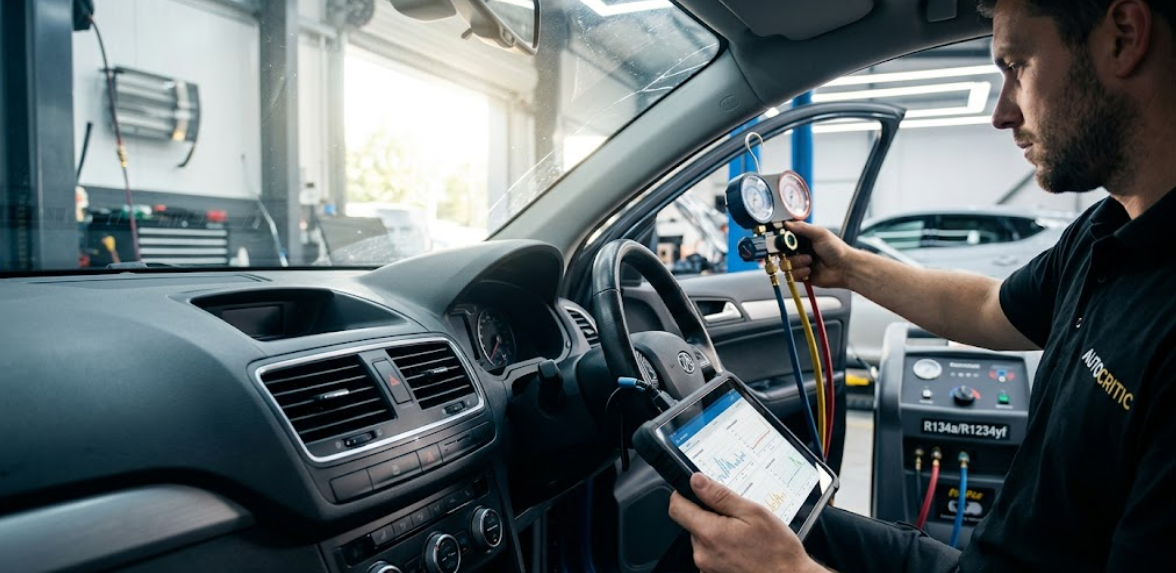
The Air Conditioning (AC) system is often the most abused component during May and June. It doesn’t just “create cold”; it removes heat via a phase-change cycle of refrigerant.
The Condenser: The Forgotten Heat Exchanger
Most owners focus on the cabin vents, but the real work happens at the condenser—the radiator-like mesh sitting behind your front grille.
- The Issue: Over the winter and monsoon, this mesh collects a “mask” of dust and dead insects. This prevents the refrigerant from shedding heat efficiently.
- The Fix: A low-pressure water rinse of the condenser fins can improve AC efficiency by nearly 15%.
Refrigerant Integrity
If your AC feels “cool” but not “cold,” you likely have moisture in the lines or a slight pressure drop. In the AutoCritic workshop, we recommend a vacuum evacuation and recharge every two years. To truly protect your car this summer, ensure your compressor isn’t cycling on and off too rapidly—a sign of pressure imbalance.
2. Tyres: Managing the Expansion and Friction
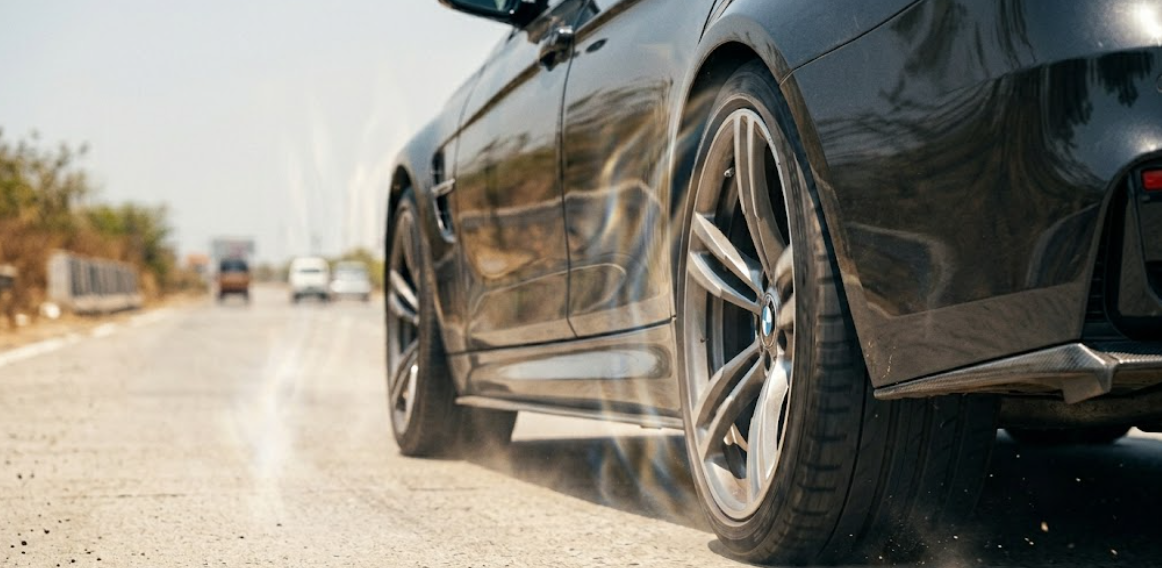
Your tyres are the only point of contact with a road surface that can reach 60°C. This leads to two critical problems: Pressure Spikes and Rubber Softening.
The PSI Paradox
There is a common myth that you should under-inflate your tyres in summer to “leave room for expansion.” This is dangerous advice. An under-inflated tyre has a larger footprint and more sidewall flex. This flex generates internal heat, which, combined with external heat, leads to a catastrophic blowout.
- The Rule: Check your pressure in the early morning while the tyres are “cold.” Stick exactly to the manufacturer’s PSI.
3. The Engine’s Cooling Circuit: Preventing Meltdown

While the AC keeps you cool, the cooling system keeps the engine alive. If your temperature needle moves even a millimetre past the halfway mark, your engine is in distress.
Coolant Chemistry
Coolant isn’t just “colored water.” It contains corrosion inhibitors and water-pump lubricants. Over time, these chemicals break down.
- The Flush: If your coolant looks brown or murky, it’s no longer protecting the internal galleries. A full flush and replacement with a 50/50 ethylene glycol mix is mandatory for summer survival.
- Hose Integrity: Squeeze your radiator hoses (when the engine is cold!). If they feel “crunchy” or excessively soft, they are about to burst under the high pressures of summer operating temperatures.
4. Lubrication and Viscosity Shear
Oil behaves differently at 100°C than it does at 40°C. In extreme summer heat, low-quality mineral oils can suffer from “viscosity shear,” where the oil becomes too thin to maintain a protective film between moving metal parts.
- The Upgrade: This is the best time to switch to fully synthetic oil. Synthetics are engineered to maintain molecular stability even under high thermal stress.
5. Preserving the Exterior: UV Defence
Indian sunlight contains high levels of UV-A and UV-B radiation. These rays don’t just fade the colour; they attack the chemical bonds of your clear coat.
- Sealants over Wax: Traditional Carnauba wax melts at around 80°C—a temperature your car’s hood can easily reach. Synthetic paint sealants or Ceramic Coatings are far superior for summer because they have a much higher melting point and offer better UV blockage.
- Plastic Trim: Unpainted black plastics are the first to “grey out.” Use a silicone-free trim restorer to prevent them from becoming brittle.
6. Interior Integrity: Protecting the Dashboard
Your dashboard is a heat sink. It absorbs solar energy and radiates it back into the cabin.
- The Windshield Shade: Using a high-quality, reflective accordion shade is the single most effective way to protect your interior. It can lower dashboard surface temperatures by as much as 20°C.
- Ventilation: If parking in a secure area, leave your windows “cracked” by just 1cm. This allows for convective airflow, preventing the greenhouse effect from building up pressure inside.
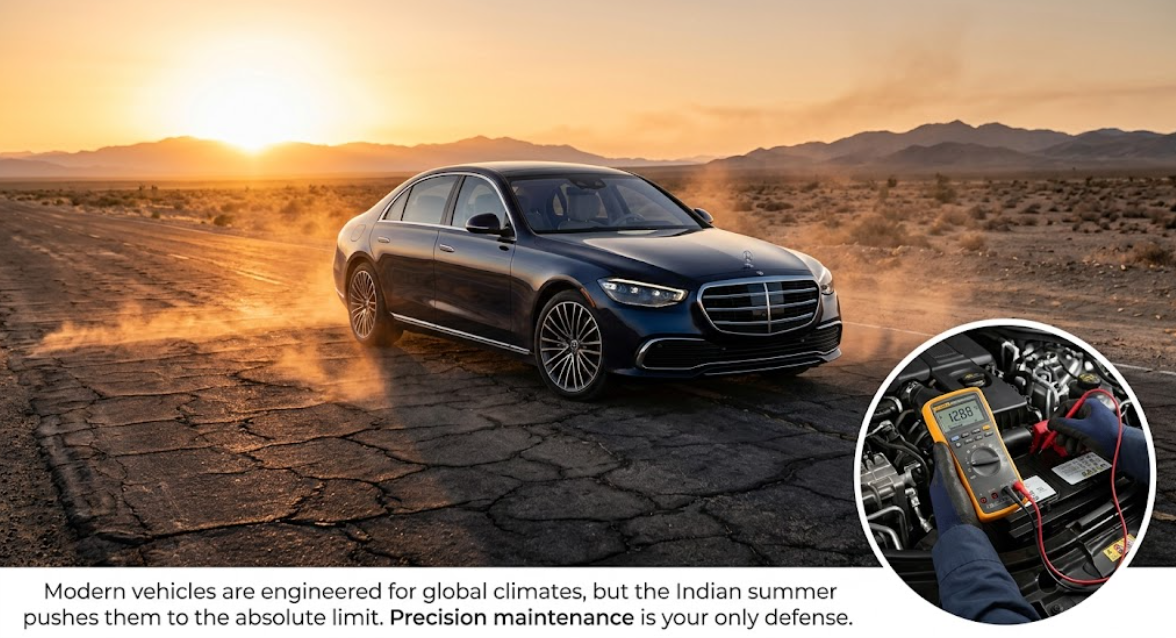
7. The Battery: The Silent Victim of Evaporation
Most people fear for their batteries in winter, but summer is the actual “silent killer.” Heat accelerates internal chemical reactions, leading to overcharging. This “boils” the electrolyte fluid inside the cells.
- The Maintenance: If you have a non-sealed battery, check the distilled water levels. For sealed (MF) batteries, check the “eye” indicator. If it’s anything but green, the heat has already taken its toll.
8. Driving Techniques for Extreme Heat
How you drive affects how your car handles the heat.
- Idle Mitigation: Avoid long idling periods with the AC on max. Without the “ram air” effect from driving, the cooling system relies entirely on the electric fan, which can struggle in 45°C+ weather.
- Early Starts: Plan your long-distance highway runs for the early morning (4 AM to 9 AM). This reduces the thermal load on the tyres and cooling system significantly.
The AutoCritic Summer Checklist (The “Off The Spec Sheet” Final Count)
To truly protect your car this summer, ensure you’ve ticked every box:
- [ ] Wiper Blades: Replace them now. Summer heat “bakes” the rubber, making them useless when the first monsoon showers arrive.
- [ ] Brake Fluid: Brake fluid is hygroscopic (absorbs water). In summer, moisture-laden fluid can boil during heavy braking, leading to a “spongy” pedal.
- [ ] Fuel Pump: Don’t run on an empty tank. The fuel acts as a coolant for the electric pump. In summer, a low tank means a hot, failing pump.
Conclusion
Understanding how to protect your car this summer is about moving from reactive to proactive maintenance. By focusing on fluid chemistry, tyre pressures, and UV protection, you ensure that your vehicle remains a reliable tool rather than a liability.
Stay cool, stay analytical, and keep it AutoCritic.
Learn more about performance in our Morphology Series.
Check out our engine deep-dives in the Past Lane Series.
For personalised advice, visit our Car Consultation Service.

Confused About Your Next Car?
Get unbiased, expert advice tailored to your budget. Cut through the jargon and make the right choice.